
Verification of Payee for Euro Deposits: How Name and IBAN Checks Changed Instant Transfers in 2026
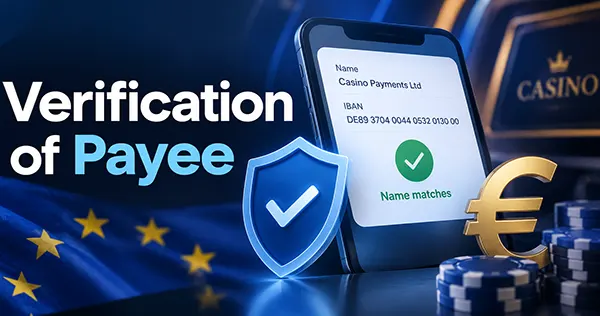
Euro bank transfers look noticeably different in 2026. Before a player confirms a deposit sent by SEPA credit transfer, many banks now check whether the beneficiary name entered for the payment corresponds to the IBAN. This Verification of Payee, or VoP, check became a mandatory part of euro credit transfers for payment service providers in euro-area EU countries on 9 October 2025 under Regulation (EU) 2024/886. Its purpose is straightforward: give the payer an additional warning before money is sent to the wrong account because of a typing error, outdated payment details or fraud. For casino deposits, the change is especially relevant when the cashier provides an IBAN for a direct bank transfer or when a pay-by-bank service ultimately initiates a SEPA credit transfer. VoP does not confirm that a casino account belongs to the person making the deposit, and it does not replace the operator’s own identity, payment ownership or anti-money-laundering checks. It verifies the intended recipient of the bank transfer before the payer authorises it.
Why Verification of Payee Now Matters for Euro Casino Deposits
The regulatory change is part of the EU Instant Payments Regulation, Regulation (EU) 2024/886, which amended the existing SEPA rules. In euro-area Member States, banks covered by the relevant requirements had to be able to receive instant euro transfers from 9 January 2025 and send them from 9 October 2025. The same October deadline introduced Verification of Payee for euro credit transfers. Importantly, VoP is not restricted to payments labelled as instant. The requirement covers both ordinary SEPA Credit Transfers and SEPA Instant Credit Transfers, so a payer may see the beneficiary check even after choosing a standard bank transfer. The verification must take place before authorisation and must be offered free of charge to the payer. As a result, by 2026 the name-and-IBAN check has become a normal step in many euro deposit journeys rather than an optional fraud feature offered by individual banks.
For a casino deposit, the most important practical point is that the beneficiary shown by the bank may not have exactly the same name as the casino brand. A gambling site can be operated by a legally registered company whose corporate name differs from the name customers normally see. Payments may also be collected through an authorised payment provider or through an account specifically used for payment processing. If the cashier states that the beneficiary is a particular company, entering only the casino’s commercial name can therefore produce a close-match or no-match warning even when the IBAN itself has been copied correctly. Players should use the beneficiary details supplied for that specific deposit rather than guessing the account name from the casino’s logo, domain name or previous transactions.
VoP also makes old saved beneficiaries more important to review. Banking apps often allow customers to reuse a recipient created months or years earlier, but payment arrangements can change. An operator can move collections to another bank, change the legal entity receiving particular transfers or issue a different IBAN for a particular market. A saved recipient should therefore not be treated as permanently valid simply because an earlier deposit was successful. When current cashier instructions differ from stored banking details, the safest course is to stop before authorisation and compare the beneficiary name, IBAN, currency and any required payment reference. VoP reduces the risk of sending money to an unintended account, but it cannot determine whether the instructions being copied are themselves current.
What the Name-and-IBAN Check Actually Does
When the payer has entered the beneficiary details, the payer’s bank or other payment service provider sends a verification request to the institution holding the beneficiary account. The request normally contains the IBAN and the beneficiary name supplied by the payer. The receiving institution compares those details with the account information in its records and sends back a result before the transfer is authorised. The European Payments Council’s VoP scheme supports results including Match, Close Match, No Match and a response indicating that verification could not be completed. The exchange happens separately from the transfer itself: VoP checks information first, while the SEPA payment is initiated only after the payer has seen the result and proceeds with authorisation.
A Match means the submitted beneficiary data corresponds to the information held for the IBAN. A Close Match means the details are sufficiently similar for the bank to recognise a likely minor discrepancy. This can happen because of a spelling variation, omitted part of a name, diacritics, transliteration or another small difference. EU rules provide that, where a name and IBAN almost match, the payer should be shown the beneficiary name associated with that IBAN so the discrepancy can be checked before payment. This is particularly useful where a casino’s instructions contain the full registered company name but the payer has entered an abbreviated version. The rules are designed so that correcting a minor mistake does not require the payer to work out the official name independently.
A No Match deserves more caution. It means the supplied name does not correspond sufficiently with the account information associated with the IBAN. The bank must warn the payer that authorising the transfer could send the money to an account not held by the intended beneficiary. This does not mean that VoP universally blocks the transfer. The regulation requires payment providers to ensure that the verification process itself does not prevent a payer from authorising the credit transfer, and European Commission implementation guidance confirms that the decision whether to continue remains with the payer. For a casino deposit, however, overriding a clear mismatch without checking the cashier details creates an avoidable risk. A payment that reaches the wrong IBAN can be considerably more difficult to recover than a deposit that was simply delayed.
How Instant Euro Deposits Work After the 2025 Rule Change
An instant euro transfer is designed to make the funds available in the recipient’s payment account within ten seconds after the payer’s payment provider receives the order, with the service operating around the clock rather than only during banking hours. This is one of the most visible changes introduced by the EU rules. A transfer can therefore reach the beneficiary account on an evening, weekend or public holiday rather than remaining queued for the next banking day. Banks are also prohibited from charging more for sending or receiving an instant credit transfer than they charge for a corresponding standard transfer. Those requirements have made instant SEPA transfers more practical for time-sensitive payments, including deposits where the casino accepts direct transfers to an eligible euro account.
The ten-second rule should not be confused with a guarantee that a casino balance will be updated within ten seconds. The banking requirement concerns the point at which funds become available in the beneficiary payment account. After that, the operator or its payment provider may still need to identify the incoming transaction and associate it with the correct player account. A payment reference, customer identifier or other instruction supplied in the cashier can be essential for that reconciliation. VoP does not check those references. Consequently, a player can receive a successful beneficiary match, send the transfer to the correct IBAN and still experience a delay before the amount appears in the casino balance if information needed to identify the deposit is missing or incorrect.
Nor does instant-transfer availability mean that every euro deposit from every European bank is instant in 2026. The implementation timetable is staggered. For payment service providers in EU Member States that use the euro, the main deadlines for receiving and sending instant payments were reached in 2025. Providers in EU Member States whose currency is not the euro have later deadlines: 9 January 2027 for receiving instant euro payments and 9 July 2027 for sending them, with the VoP deadline for those Member States also falling on 9 July 2027. There are also specific transitional rules for certain payment and electronic-money institutions. A player using an account in a non-euro-area country may therefore still find in 2026 that an instant euro option or a VoP result is not available in exactly the same way as it is through a euro-area bank.
What Match, Close Match, No Match and Check Not Possible Mean
A Match is the clearest result and indicates that the beneficiary information supplied for the transfer corresponds to the account data checked by the beneficiary’s payment provider. It is still important to review the amount and any payment reference before confirmation because VoP is not a complete validation of the deposit. It does not tell the payer whether the amount is within the casino’s deposit limits, whether the player account is eligible to receive the deposit, whether a particular reference has been entered correctly or whether the transfer complies with the operator’s payment rules. It should be viewed as one targeted safeguard: confirmation that the intended beneficiary information and payment account correspond, not a blanket approval of every other part of the transaction.
A Close Match is different from both a full Match and a rejection. It generally indicates that the name is similar to the registered beneficiary but not identical enough for the strongest matching result. Minor spelling errors are an obvious example, but differences can also arise from accents, transliteration between alphabets, common names versus formal names or shortened corporate wording. Under the regulation, an almost-match result can be accompanied by the correct beneficiary name so that the payer can compare it with the intended recipient. The European Commission has also stressed that disclosure has to respect data-protection rules; the mechanism is not intended to let someone enter random IBANs in order to reveal account holders’ identities.
A No Match indicates a substantial discrepancy, while Verification Not Possible means the verification could not provide a usable answer. Those outcomes should not be treated as equivalents. A No Match actively signals that the submitted beneficiary details do not correspond, whereas an unavailable check can arise because the relevant institution or account cannot currently return the required verification result. The latter is therefore neither confirmation that the details are correct nor proof that they are wrong. The EPC scheme recognises Match, Close Match, No Match and Verification Not Possible responses, and the payer’s bank communicates the result before authorisation. When a casino deposit produces anything other than a clear or readily explainable match, current payment instructions should be checked before money is sent.

What Players and Casino Payment Teams Should Do in 2026
For players, the best way to use VoP is as an additional confirmation rather than a reason to pay less attention to the cashier instructions. The beneficiary name should be entered exactly as provided, particularly when the recipient is a limited company rather than the casino brand itself. The IBAN should be copied from the current deposit page, and any mandatory payment reference should be reproduced separately in the field requested by the bank. If the bank displays a corrected beneficiary name after a close match, that name should be compared with the legal or payment information shown by the casino. A completely unfamiliar company name should not simply be accepted because the IBAN looks familiar. It is better to verify the payment details through the casino’s official support route before authorising a transfer that cannot easily be reversed.
Casino payment teams, meanwhile, have a practical reason to present bank-transfer instructions with much greater precision than before VoP became widespread. Showing only an IBAN is no longer enough for a smooth customer journey. The beneficiary name displayed in the cashier should reflect the name against which the receiving bank performs its check, with consistent spelling and corporate suffixes where they matter. If a payment processor rather than the casino operator receives the funds, that distinction should be made clear before the customer opens their banking app. Instructions should also separate the beneficiary name from the payment reference because the two fields have different purposes: the first helps VoP identify the recipient, while the second may help the casino allocate the transfer to a particular account.
2026 is also a transitional year for the European VoP framework itself. The European Payments Council’s original VoP Scheme Rulebook entered into force on 5 October 2025 and supported the rollout ahead of the euro-area regulatory deadline. Version 1.1 was published on 16 March 2026 with clarifications arising from the first months of implementation and is scheduled to become effective on 20 September 2026. As of 8 September 2026, the original version remains the operative EPC rulebook. These technical refinements do not fundamentally change what a casino customer sees: the essential process remains a pre-payment check of the beneficiary details followed by a result that helps the payer decide whether the transfer should be authorised.
Common Deposit Problems and How to Avoid Them
One of the most common sources of confusion is entering the casino brand as the beneficiary when the receiving account is registered to another legal name. Another is reusing details from an earlier deposit after the operator has issued a new IBAN. Typographical errors can affect both fields: a single incorrect IBAN character may point to an invalid or entirely different account, while an abbreviated or misspelt company name can trigger a close-match warning. The practical response is simple: use the details displayed for the current transaction and read the bank’s verification message before confirming. A warning should not be dismissed merely because a previous transfer to a similarly named recipient succeeded.
Another problem arises when users assume that a successful VoP result proves that a casino or payment request is legitimate. It does not. The EPC itself describes VoP as a messaging service that verifies particular payee data and notes that it is not a means of identifying a private or legal person. A fraudster who controls an account could still supply the correct registered name for that account, producing a match even though the underlying request is fraudulent. Players should therefore access deposit details through the genuine casino account rather than through payment instructions received unexpectedly by email, social media or an unsolicited message. VoP reduces certain forms of misdirected payment and impersonation fraud, but it does not replace basic checks on where the payment instructions came from.
The most useful change in 2026 is therefore not speed alone but the extra information available before a euro transfer becomes final. Instant payments can move money to the recipient in seconds, so an error that once might have remained in a banking queue can now be completed almost immediately. Verification of Payee places a beneficiary check immediately before that point and gives the payer a chance to notice a wrong name or incorrect account relationship while the money is still under their control. For euro casino deposits made by bank transfer, the sensible routine is to use current cashier details, enter the stated legal beneficiary rather than assume the brand name, check the VoP response, keep any required payment reference intact and remember that successful bank settlement and crediting of the casino balance are separate stages. That combination makes instant transfers easier to use without treating speed as a substitute for careful payment verification.